The Algorithm of Anguish: Examining Doomscrolling and Gen-Z Mental Health
Laiba Labeeb Bajwa & Rafia Mohsin
University of Management and Technolog, Lahore
The present research explored the association between doomscrolling, and mental health problems in Gen-Z. In this correlational and cross-sectional research, data (N=250) was collected from students of both private and public universities by using purposive and quota sampling technique. The sample included equal number of males, and females (125 each) with age range of 18-25 years. The data collection protocol included permission letter, consent form, demographic sheet, Doomscrolling Scale (DS; Sharma et al., 2022), and Depression, Anxiety, and Stress scale (DASS-21; Lovibond & Lovibond, 1995). IBM-SPSS statistics was used to run the statistical analysis. Correlation analysis showed doomscrolling to have a significant positive moderate relationship (0.27**) with mental health problems. Regression analysis depicted doomscrolling to be a significant positive predictor of mental health problems in Gen-Z. Future research should explore the longitudinal impacts and the effectiveness of digital literacy programs as a preventive approach.
Keywords: doomscrolling; mental health problems; gen-z
A school student is an individual who attends an educational institution known as a school for the purpose of receiving formal instruction, acquiring knowledge, and developing various skills. They can learn about themselves, their surroundings, and the world through education and awareness. We can use this knowledge to make informed decisions about the future. Educators can inculcate in their students the habit of becoming introspective, conscientious learners. By helping students become more conscious of their cognitions as a process, the gap could be closed between their actual and projected abilities in our schools by allowing them to better understand how specifically they are thinking and learning. Metacognition is the process of thinking about thinking. Children who are able to acquire metacognitive skills are equipped for lifelong learning. Teenagers have highly developed metacognitive skills than young children. Teenagers continue developing cognitively, but they also still undergo metacognitive development. Increasing students’ effectiveness, and more significantly their autonomy, requires them to develop their metacognitive awareness. The most efficient methods of learning can be acquired if students are aware of how they learn. Students should be empowered with metacognitive training, because it helps them comprehend the working of their own thought processes (Weil et al., 2013).
Flavell was the one who initially used the term "Metacognition" (1979). To optimize learning, he defined metacognition as the conscious capacity of an individual to comprehend, manage, and regulate his or her own cognitive process. Cognitive knowledge and regulation of cognition constitute the two components of metacognition. The term "knowledge of cognition" (metacognitive knowledge) describes the understanding of the reading learning process. The ability to use strategies has an impact on the cognitive process. It applies to knowledge that is declarative (i.e., know what), procedural (i.e., know how), and conditional or strategic (i.e. know why) (Flavell, 1979).
These categories were eventually expanded, and sub-components were identified by additional research (Flavell et al., 1987). Definitional (declaration), methodological (process), and situational knowledge were used to differentiate the components of cognition knowledge. Planning, knowledge management techniques, self-monitoring, debugging (i.e., repair), and regulative competencies, such as assessment, were other categories for the regulation of cognition (Brown,1987).
At its core, metacognition means the ability to think about one's thinking. It is crucial for several cognitive functions, such as problem-solving, decision-making, and learning. As individuals engage in metacognitive processes, they become better equipped to adapt and optimize their cognitive strategies, leading to improved performance and knowledge acquisition (Hacker & Dunlosky, 2009). Among children of ages between 3 and 5, concurrent with the improvement of theory of mind, metacognitive processes also begin and can last a lifetime. The ability to consider one's own and other people's mental states is a critical social- cognitive skill which is included in the concept of theory of mind, which also covers metacognitive abilities. Parallel to the growth of cognitive processes, metacognition and theory of mind develop more quickly, especially in students. The child's academic performance, motivation, interpersonal relationships, and social relationships are all impacted by this developmental stage (Pezzica et al., 2018).
Metacognition is the application of cognition to cognition and is described as any knowledge or cognitive process involved in the assessment, instruction, and monitoring of thinking and cognitive activities. The importance of metacognition has been clearly explained by studies. Metacognition, the ability to reflect on and control one's own thought processes, is crucial in various aspects of cognitive functioning. Research suggests that individuals with strong metacognitive skills exhibit enhanced learning outcomes, as they are better equipped to understand their own cognitive processes and choose effective learning strategies (Brown, 2019; Smith & Johnson, 2020). Moreover, metacognition is closely linked to improved problem-solving abilities, allowing individuals to approach challenges with a strategic mindset and evaluate the effectiveness of their problem-solving strategies (Johnson et al., 2021). The significance of metacognition extends beyond academics; it fosters self-regulation by enabling individuals to set and monitor personal goals, thus influencing their overall emotional and motivational well-being (Robinson & Garcia, 2018).
There are multiple studies on students’ metacognition; however, in the majority of these studies, the metacognition has been assessed using an inventory which was created in a western cultural context. This study is based on the context of the cognition that is being centered on six dimensions: cognitive planning, adaptability, awareness, regulation, monitoring and reasoning. The purpose of the current study is to fill the gap caused by the lack of a metacognition measure among school students. Recognizing and addressing metacognition are essential for promoting the well-being, academic achievement, and overall development of students. Schools and communities can play a vital role in providing support and resources to help students thrive in these areas.
There is no scale available in Pakistan. This scale is greatly needed in our society. The evaluation of metacognition is very important. But unfortunately, for this purpose there was no scale available which could assess the metacognition of students. According to Pakistani culture, there is limited work on scale development especially on the metacognition of students. This study is designed to fill the gap regarding this non-availability of metacognition scale among school students in context of Pakistani culture, and includes students with a background of the Pakistani culture. It also determines the psychometric properties of newly developed metacognition scale for students.
This study will highlight the factors related to the metacognition scale, especially in the Pakistani culture. It would be supportive for researchers, social scientists in a similar field and students of social sciences. It will highlight the awareness in educational institutions in district Gujrat. Based on analytically obvious material about metacognitive factors, and their operative contribution in the awareness programs on suicidal ideation can prime toward best level of development of cognition level and it can assist students to progress their educational presentation by promoting positive interactions and contributing to a more compassionate society.
Method
Phase I: Development of MSCA
The scale MSCA was developed (Phase I) and its psychometric properties determined (Phase II) in two phases. Phase I was further divided into three stages, generating items based on the model (Kallio, et al. 2018) and a literature review (Stage 1). Experts evaluated these items (Stage 2) and carryied out a pilot study which determined clarity and use of MSCA in adolescents (Stage 3).
Item Pool (Stage 1)
A pool of items was generated using a metacognitive model (Kallio et al., 2018) through a deductive approach. This approach took into consideration the conceptualization of metacognition and its two domains which aligned with the Pakistani culture. The first domain focused on how children and adolescents would respond to items which would depict that they were aware of what was known to them (metacognitive knowledge), and the second domain focused on how they would regulate their knowledge or cognition (metacognitive regulation) as proposed in the previous research (Schraw & Dennisson, 1994; Schraw, Crippen, & Hartley, 2006). A total of 45 items were thus generated with the assistance of three specialists in the field of psychology.
Content Validity (Stage 2)
A panel of five experts (3 PhD and 2 MPhil scholars from Department of Psychology, University of Gujrat) established the content validity (Creswell, 2005) of MSCA. Panelists rated each item on a Likert scale, based on the appropriateness of each item relative to the metacognitive model, as well as the clarity of wording and the choice of words ranging from 1= essential, 2= useful but not essential to 3= necessary. Content validity of the pool of items was analyzed by Cohen’s content validity ratio or CVR [(Ne - N/2)/N/2)] and was calculated for the scale (Swerdlik & Sturman, 2013), where "Ne" represents the number of experts who rated an item as "essential”, and "N" is the total number of experts involved in the evaluation. The experts also assessed word clarity of items on a 3-point response scale where word clarity ranged from 1 = useful but not essential, 2 = essential, and 3= necessary; and assessed unsuitability and their disinclination of using items. Experts considered 39 items in the pool were appropriate, however, six items were removed because of redundancy. Slight changes in wordings were made on some of the items to make them easily readable. Items were considered to be suitable following the Lawshe (1975) statistically valid ratio.
Pilot Study (Stage 3)
A convenient sample of 45 male and 45 female (N = 90) students (age range 11-17 years) from schools of Lalamusa were taken to carry out the pilot study, in which the students completed 39 items. This study empirically tested these items with a student sample for comprehension and clarity. After getting permission from school heads and principals, students’ consent was also taken and they were briefly told (in Urdu) about the purpose of the study as well as given instructions to complete the items. Their personal identities were kept confidential. Average time to complete the pool of items was 5-10 minutes rendering a high (alpha = .98) internal consistency (Downing, 2004). All 39 items were dubbed as MSCA for further psychometric analyses.
Phase II: Psychometric Properties of MSCA
Psychometric properties of MSCA included measures of internal consistency, Exploratory Factor Analysis (EFA), and Confirmatory Factor Analysis (CFA).
p>SampleBy means of a two-stage sampling technique the target population was divided into two stages. Each of these stages was divided between public and private schools from Gujrat and Lalamusa. At stage 2 it was divided into an age range from 11 to 17 years and the last into genders boys and girls. 460 participants willing to take part in the study were recruited from various government and private schools. Participants with any form of physical disability or psychological illness were excluded from the study.
Regarding the demographic characteristics, most of the sample (57.4%) belonged to rural area, whereas 42.6% belonged to the urban area. The greater number of respondents (61.1%) fall in the nuclear family system, whereas 38.9% respondents fall in the joint family system. Furthermore, the majority of the participants (20.7%) were of 16 years, 8.5 % of the participants were 11 years, 10.2 % of the participants were 12 years, and 11.3% were of 13 years, 18.7% were 14 years, 16.1% of the participants were 15 years, and 14.6% of the participants were 17 years old. The participation of girls was 57.4% in the sample and boys were 42.6%. Both categories were based on their total proportion in the target population. Public sector institutes had respondent’s equivalent to 44.1% in the sample, and the private sector had participant’s equivalent to 55.9%.
Assessment Measure
Item Pool for Metacognitive Scale. Metacognition Scale was measured through the MSCA with 39 items. The response pattern was based on a 5-point Likert scale ranging from always (5) to absolutely not (1). It showed good internal consistency of .975 in the pilot study. On average it took 10 minutes. Demographic Form. The demographic form included variables such as school type, gender, residential area, socioeconomic status, age, father’s qualification, mother’s qualification, number of siblings, birth order, family system, and monthly income.
Procedure
The initial form of Metacognition was administered to students between the ages 11-17 in the form of groups. After getting permission from the school and principals, the participants were approached. After delivering a brief introduction to the school students, the main objective of the research was described to them. From each participant a written consent was elicited. They were requested to answer each stated item as per their awareness and closely associated to their conditions. On average, completing the initial metacognition form took 5- 10 minutes. Ethical principles, including informed consent and confidentiality, were upheld throughout the study. Participants were informed of their right to withdraw from the research at any time they wished. The risk-benefit ratio was monitored, and participants were not required to disclose their identities; instead, they were assigned ID numbers.
Results
First EFA was run with 39 items, in anti-image correlation 5 items were deleted because of value of correlation is less than 0.4. Then again EFA was run with the 34 items. Table-3.6 indicated Kaiser-Meyer-Olkin (KMO) tests the suitability of the sample for the 34 items. The KMO value was. 900. It indicated that the data was appropriate for factor analysis. The R- matrix and metacognition data set are factorable, according to Bartlett’s test of sphericity, which revealed an X2 value of 4851.292 (p <.001) and the suitability of the data set for Exploratory Factor Analysis. Table-4 clearly indicated that most of the items have high loading values ranged from .3 to .9. Signifying that all factors have maximum number of items. The scree plot demonstrates factor solution after 7th component with a clear gap. Considering the factor loadings and theoretical relevance, only 7 well-defined factors emerged. After conducting the Exploratory Factor Analysis (EFA), 32 items on metacognition were retained. EFA is used to "estimate or eliminate factors and determine how many factors should be retained or rotated in an interpretable orientation (Floyd & Widaman, 1995). Principal Component Analysis (PCA) was used to determine the factor structure in the items after EFA was run with Varimax rotation. Initial analysis using the Kaiser-Gutzman criterion and Eigen values > 1.00 produced a 7-factor solution accounting for 52.96 percent of the total variance. Given that the scale was only measuring single constructs, some items have dual loading, but this is to be predictable. Therefore, the factors’ structure must have been established with the items’ theoretical relevance and high loading in consideration. Moreover, item no 34 had high factor loading in factor no 5 as compared to factor 4 so it placed in factor 5 and item 26 is theoretically fit into factor 5 but loading is high in factor 2 so due to theoretically relevance it is placed into 5th factor. On the basis of model, researcher labelled the 7 factors as Factor 1 labeled as Cognitive planning, Factor 2 as Adaptability, Factor 3 as Awareness, Factor 4 as Regulation, Factor 5 as Monitoring, Factor 6 as Reasoning and Factor 7 as Adjustment.


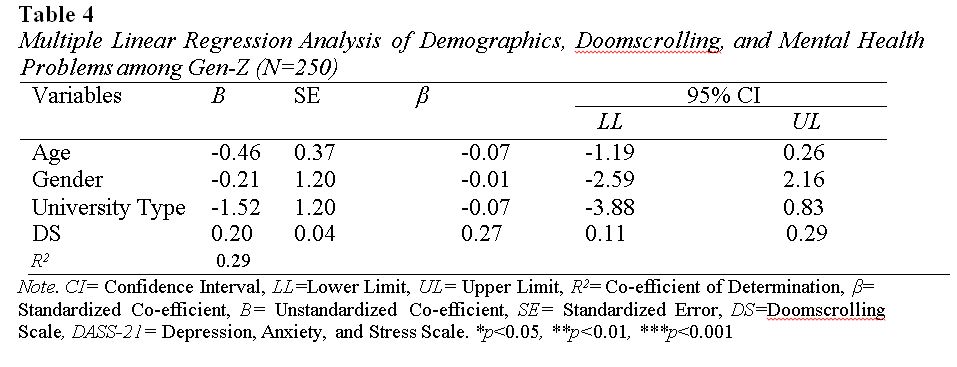
Multiple Linear Regression was used to find out the predictors of mental health problems in Gen-Z. This table shows R2= 0.29 that regression model explains 29% of variance in mental health problems scores. Multiple Linear Regression showed that doomscrolling was found to be significant positive predictor of mental health problems, while age, gender, and university type were found non-significant negative predictors of mental health problems.
Discussion
The present research studied the relationship between doomscrolling, and mental health problems in Gen-Z, revealing that doomscrolling is a significant positive predictor and is positively correlated with mental health problems in Gen-Z. The present study verifies previous findings by looking at the association between doomscrolling and these mental health problems in the current group.
Rodrigues (2023), in a narrative review of existing literature, emphasized that extended exposure to negative social media content increases stress, and anxiety. Moreover, she found out that doomscrolling led to hopelessness. Rodrigues highlighted that those who were doomscrolling were actually subjected to more psychological distress as it served as a threat to mental health. The results of the present research compared with that of Rodrigues support the understanding that doomscrolling leads to psychological distress, thus validating the current findings. Similar research on a sample of 1,000 university students aged 18-28 years, with 15 participants selected through purposive sampling who exhibited high levels of doomscrolling, found that excessive doomscrolling was associated with increased anxiety and emotional exhaustion among university students (Usman et al., 2025). The current study's findings are congruent with earlier conclusions, since both studies show a substantial link between doomscrolling and mental health issues. The closeness in findings can be linked to similar demographic features, notably the prevalence of Gen-Z who are heavily involved with digital media and online news consumption.
A cross-cultural study examined the psychological impact of doomscrolling across 675 university students (18-65 years) from Iran and the United States. The results signified that overconsumption of negative news was linked with increased levels of stress, existential anxiety, and excessive worry about future events in both cultures (Shabahang et al., 2024). The similarities between their work and the present study support our hypothesis that doomscrolling has a negative effect on mental health, therefore causing stress and anxiety. Furthermore, the consistent direction of the relationship across studies suggests that increased exposure to doomscrolling is a common risk factor for anxiety and stress, implying a potentially universal link between doomscrolling and poor mental health outcomes among Gen-Z. Similarly, a 2025 study of 235 adults in Singapore discovered that doomscrolling was associated with higher levels of psychological distress, including depression, anxiety, and stress, and that this distress mediated the relationship between doomscrolling and secondary traumatic stress symptoms associated with social media use. This study found that doomscrolling can cause psychological distress similar to trauma, thereby contributing towards mental health problems (Ang, 2025). Correspondingly, the present research findings also align with results of another research which found that individuals who engaged in doomscrolling developed higher depressive symptoms, thereby linked to poorer mental health (Price et al., 2022).
Furthermore, a key discovery was the issue's demographic universality, since doomscrolling was unrelated to gender or university type. This shows that susceptibility is not isolated to a single grouping, but rather a generational trademark, most likely resulting from a common identity as digital natives who are universally exposed to the architectural design of social media platforms (Satici et al., 2022).
This study also contributes to the current knowledge by revealing the powerful impacts of doomscrolling in a non-Western, developing society. For Pakistani Gen-Z, the internet domain is more than just a source of global news; it also provides a constant stream of material regarding local political instability, economic inflation, and social difficulties. The authors believe based on their observations that lack of strong mental health support services, along with existing societal stigma, exacerbates the problem, generating a unique pressure cooker effect. In this context, doomscrolling may be a maladaptive effort to exert control over huge and sometimes insurmountable real-world pressures, making the current findings especially important for regional public health initiatives (Abbasi at al., 2025).
The findings of this study also have significant implications for mental health experts, educational institutions, and digital platform builders. Universities should proactively include digital literacy and a critical consumption curriculum into their student orientation and wellness programs. These classes should go beyond technical skills and educate information hygiene, which includes recognizing algorithmic manipulation, setting purposeful time limits for news intake, and developing thoughtful participation with social media to reduce obsessive scrolling. Clinicians should make measuring clients' digital behaviors a regular element of their mental health exams. Furthermore, engagement with technology businesses is critical for advocating and developing ethically designed platform features such as customizable algorithms, well-being cues, and break reminders that enable users to escape the loop of negative reinforcement. On a personal level, the study provides the valuable insights for individuals seeking to improve their digital habits and mental health. By understanding the intricate relation between doomscrolling and mental health, this research can empower Gen Z to develop healthier relations with digital media.
Even though it has contributed, this research has various limitations. Firstly, this study used a cross-sectional design, which limits the changes, and the long-term effects could not be examined. Secondly, data were collected via self-report measures, which may be subject to social desirability or recall biases. Thirdly, the sample was limited to university students in Lahore, restricting generalizability to other regions or age groups. Purposive and quota sampling may have introduced selection bias, potentially affecting the representativeness of the findings.
Future research should employ longitudinal or experimental designs to provide stronger evidence as how doomscrolling affects mental health in Gen-Z over longer period of time. Moreover, future research should include more diverse representative samples from different cities, and age groups, and educational backgrounds to improve generalizability.
Correlating sets of results from the same individuals on two successive administrations of the same test allows for the investigation of test-retest reliability (Cohen et al., 2013). To examine the consistency of Metacognition results over a three-week period on the same sample (n=200), test-retest reliability of the Metacognition was conducted. Results indicated significant higher correlation (r=.892**, p<.01) between 2 administrations of Metacognition. It indicated excellent test-retest reliability.
Conclusion
In conclusion, the present study demonstrates a significant positive relationship between doomscrolling and mental health problems, including depression, anxiety, and stress, among Gen-Z. Doomscrolling emerged as a significant predictor of mental health issues, regardless of gender or university type, highlighting its universality. Overall, the study underscores the importance of addressing excessive negative media consumption to safeguard Gen-Z mental health.
References
Abbasi, P. N., Gillani, S. A., & Rashid, A. (2025). From perceived ostracism to mental exhaustion: Illuminating the link of doomscrolling and digital detox. Pakistan Social Sciences Review, 9(1), 575–591. https://ojs.pssr.org.pk/journal/article/view/943
Alruthaya, A., Nguyen, T.-T., & Lokuge, S. (2021). The application of digital technology and the learning characteristics of Generation Z in higher education. CoRR. https://doi.org/10.48550/arXiv.2111.05991
Ang C. S. (2025). Doomscrolling and secondary traumatic stress: Psychological distress and just world belief as potential mediating pathways. The Psychiatric Quarterly. https://doi.org/10.1007/s11126-025-10236-5
Brailovskaia, J., & Margraf, J. (2021). The relationship between burden caused by coronavirus (COVID-19), addictive social media use, sense of control and anxiety. Computers in Human Behavior, 119, 106720. https://doi.org/10.1016/j.chb.2021.106720
Jayatissa, K. A. D. U. (2023). Generation Z – A new lifeline: A systematic literature review.Sri Lanka Journal of Social Sciences and Humanities, 3(2) 179-186 https://doi.org/10.4038/sljssh.v3i2.110
Keles, B., McCrae, N., & Grealish, A. (2020). A systematic review: The influence of social media on depression, anxiety and psychological distress in adolescents. International Journal of Adolescence and Youth, 25(1), 79–93. https://doi.org/10.1080/02673843.2019.1590851
Kellerman, J. K., Hamilton, J. L., Selby, E. A., & Kleiman, E. M. (2022). The mental health impact of daily news exposure during the COVID-19 pandemic: Ecological momentary assessment study. JMIR Mental Health, 9(5), e36966. https://doi.org/10.2196/36966
Lovibond, S. H., & Lovibond, P. F. (1995). Manual for the Depression Anxiety Stress Scales (2nd ed.). Psychology Foundation.
Odgers, C. L., & Jensen, M. R. (2020). Annual research review: Adolescent mental health in the digital age. Journal of Child Psychology and Psychiatry, 61(3), 336–348. https://doi.org/10.1111/jcpp.13190
Rideout, V., & Robb, M. B. (2018). Social media, social life: Teens reveal their experiences. Common Sense Media. https://www.commonsensemedia.org
Satici, S. A., Tekin, G. E., Deniz, M. E., & Satici, B. (2023). Doomscrolling scale: its association with personality traits, psychological distress, social media se, and wellbeing. Applied Research in Quality of Life, 18(2), 833–847. https://doi.org/10.1007/s11482-022-10110-7
Schulte-Körne G. (2016). Mental health problems in a school setting in children and adolescents. Dutsches Arzteblatt international, 113(11), 183–190. https://pmc.ncbi.nlm.nih.gov/articles/PMC4850518/