Effectiveness of Third Wave CBT Techniques for Anger Management among Pakistani University Students
Sidra Zaki, Saniya Samreen, & Kehkashan Arouj
Air University Islamabad and International Islamic University Islamabad
This study examines the effectiveness of third-wave Cognitive Behavioral Therapy (CBT) techniques in managing anger among university students in Pakistan. Participants ranged in age from 18 to 25 years. A quasi-experimental design was used and conducted in two phases. In the initial phase, 75 participants were screened using the Clinical Anger Scale (CAS). Forty participants exhibiting moderate to severe anger were selected and randomly assigned to experimental and control groups. In the second phase, the experimental group received third-wave CBT interventions, including Acceptance and Commitment Therapy (ACT), Dialectical Behavior Therapy (DBT), and mindfulness-based techniques, while the control group received treatment as usual. Findings revealed that third-wave CBT techniques led to a significant reduction in anger symptoms compared to the control group. These results highlight the cross-cultural applicability of third-wave CBT and its potential to enhance emotional regulation and resilience among university students.
Keywords: Third Wave CBT, Anger Management, University Students
The human psychological framework reflects a complex interplay of cognitions, behaviors, and emotions. Emotions fluctuate in intensity and frequency, often shaping individuals’ actions and psychological outcomes. Anger being an integral emotion in human life, may help an individual to increase the productivity and may also bring dysfunctionality in one’s life (Buss & Perry, 1992). This construct of anger comprises three domains namely affective, cognitive, and behavioral. Although distorted thought patterns in anger provoking situations often make an individual behave in a hostile or aggressive manner, yet the core component that ignites an individual may be the emotional reaction that stems in a fraction of a second after the situation (Pashupati & Dev, 2011). Gaining insight on regulating one’s emotions is adaptive in enhancing emotional well-being particularly in anger situations (Mauss et al., 2007).
Adolescents and young adults experience prominent changes in their psychological processes and behavioral expression. This phase of life is considered as “a period of vulnerability”, marked by hormonal rush. University students also undergo a similar transition in their life. During this stage, individuals become emotionally responsive, and emotions such as love, jealousy, anger, and fear often intensify (Weinrabe & Hickie, 2021). University students are surrounded by numerous challenges including the need to excel academically, as well as making an identity of their own. This tug of war between various expectations often leads to anger, frustration, low self-esteem and self-criticism which in turn causes hurdles in maintaining a smooth functioning of one’s life (Çevik, 2017). Poor anger management can result in relationship issues and increased vulnerability for psychopathologies as well.
Anger issues among university students is a global issue (Khurshid et al., 2017; Chatterjee, 2016). In Pakistan, approximately 86% of university students report anger-related issues, often linked to academic stress and emotional dysregulation (Khurshid, Parveen, & Yousuf, 2020). Bibi, Saeed, and Khalid (2019) concluded in their study that low emotional intelligence significantly predict aggressive tendencies and anger among university students. Research evidence from the Pakistani culture indicates that anger is a significant emotional concern among university students with mostly focusing on more traditional therapeutic methods such as Cognitive Behavioral Therapy (CBT) or pharmacological treatments (Khan et al., 2021).
Cognitive Behavior therapy has been used for anger management and its efficacy has been well established with respect to cognitive restructuring and behavioral modification, however the role of fostering acceptance, mindfulness, and personal values remained unattended there (Hayes & Hofmann, 2017). Third-wave CBT expands upon traditional CBT by emphasizing mindfulness, acceptance, and personal values to promote long-term emotional flexibility rather than symptom reduction alone (Hayes & Hofmann, 2017). This includes different therapeutic techniques from Dialectic Behavior Therapy, Acceptance and Commitment Therapy, Self Compassion and Mindfulness based Cognitive Behavior Therapy (Brown, Gaudiano & Miller, 2011). These therapies are predominantly effective in fostering adaptive coping strategies and resilience in young adults leading to better emotional regulation.
Furthermore, these techniques are used in various researches for reducing symptoms of various disorders and emotional problems. In a study conducted by Benfer, Spitzer & Bardeen (2021) it was reported that third wave therapies demonstrated promising results in managing post-traumatic stress symptoms. Perkins et al. (2023) examined the effectiveness of third wave CBT techniques for children and adolescents in a systematic review. The findings indicated significant efficacy in improving emotional and behavioral dysregulation. The efficacy of Dialectic Behavior therapy has also been reported in addressing anger issues of adolescents and young adults. A significant improvement in mindfulness and emotional tolerance was observed in this study (Neukel & Herpertz, 2022). Acceptance and commitment therapy has been used by therapies for management of different psychological issues. Marsa, Poorani, Zarei, Shojaei, and Aghchi (2024) conducted a quasi-experimental study using ACT. Results reported significant reduction in anger symptoms and enhanced self-compassion among women with chronic pain.
In collectivistic contexts such as Pakistan, societal and familial expectations increase pressure on young adults to fulfill multiple roles, often leading to frustration, self-criticism, and anger (Chitrakar & Nisanth, 2023). Individuals tend to justify all these roles and go through pressure leading to frustration, self-criticism, anger outbursts and stress (Chitrakar & Nisanth, 2023). Additionally these individuals are not well equipped with emotional regulation, self-compassion and acceptance related skills. Around 60% of university students are reported exhibiting significant anger issues and they face outcomes such as poor self-esteem, poor academic performance and difficulty in maintaining their social ties (Ansar, Naveed, Khattak, & Khan, 2023). Traditional CBT techniques focusing on cognitive reframing have shown promise in anger management, yet evidence regarding third-wave CBT approaches remains limited in Pakistan. Given their emphasis on acceptance, self-compassion, and emotional flexibility, these interventions align well with cultural values surrounding self-control and interpersonal harmony. Therefore, this study aims to examine the efficacy of third-wave CBT—specifically ACT, DBT, and mindfulness-based techniques—in managing anger among university students. The objective of this study was to evaluate the effectiveness of third-wave Cognitive Behavioral Therapy techniques in managing anger among university students in Pakistan.
Method
A randomized controlled trial (pre-test and post-test design) with an experimental group and a control group was conducted in the current study. Participants were randomly assigned to groups to ensure baseline equivalence. The sample consisted of 40 university students aged 18 to 25 years, recruited from universities in Islamabad. Participants were randomly assigned to experimental and control groups. Screening was carried out using the Clinical Anger Scale (CAS), and those scoring in the moderate to severe range were included. Individuals with diagnosed psychological disorders or those undergoing major life transitions or adjustment difficulties were excluded from participation.
Assessment Measures
Clinical Anger Scale (CAS; Snell et al., 1995)
The Clinical Anger Scale is a 21-item self-report questionnaire designed to assess the intensity of anger as a clinical symptom. Each item is rated on a four-point Likert scale, yielding total scores from 0 to 63. Higher scores indicate greater severity of anger. Scores between 0–13 reflect minimal anger, 14–19 mild anger, 20–28 moderate anger, and 29–63 severe anger. The instrument demonstrates excellent internal consistency, with a Cronbach’s alpha of .94.
Procedure
Approval for the study was obtained from relevant institutional authorities by the Institutional Review Board. The study was conducted in two phases. In the first phase, 75 students were using the screened Clinical Anger Scale (CAS) and a demographic questionnaire. Informed consent and the right to withdraw from the study were ensured, and confidentiality of all responses was maintained. Based on the inclusion criteria, 40 students showing moderate to severe anger scores were selected and randomly assigned to experimental or control groups. In the second phase, the experimental group received third-wave CBT–based anger management interventions, while the control group received treatment as usual which consisted of the standard support available at the university, including brief counseling sessions and psychoeducation. The intervention was carried out by a trained Clinical Psychologist. Post-therapy assessments were completed by re-administering the Clinical Anger Scale at the end of the intervention period. The intervention plan was adapted to individual needs, with therapy duration ranging from 8 to 14 sessions of 40–45 minutes each.


Results
Data were analyzed using SPSS Version 23. Descriptive statistics, including means and standard deviations, were computed for study variables, while frequencies and percentages were calculated for categorical data. The sample comprised 23 women (57%) and 17 men (43%), with a mean age of 20 years. The Cronbach’s alpha reliability coefficient for the Clinical Anger Scale (CAS) in this study was .81. A paired-sample t-test was conducted to compare pre- and post-intervention CAS scores for the experimental and control groups.
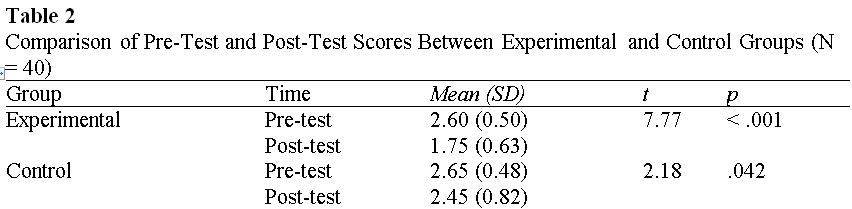
CAS scores are reported as the mean item score rather than total scores. The CAS consists of 15 items, each rated on a 0–4 scale, with higher scores indicating greater anger severity. Scores for each participant were averaged across all items, yielding a possible mean score range of 0–4. Thus, the pre-intervention mean of 2.60 and post-intervention mean of 1.75 for the experimental group reflect average item scores rather than raw total scores.
Paired-sample comparisons showed that the experimental group’s anger scores decreased from pre-intervention (M = 2.60, SD = 0.50) to post-intervention (M = 1.75, SD = 0.63), t(19) = 7.77, p < .001, Cohen’s d = 1.74, indicating a large effect size. The control group showed a smaller reduction from pre-intervention (M = 2.65, SD = 0.48) to post-intervention (M = 2.45, SD = 0.82), t(19) = 2.18, p = .042, Cohen’s d = 0.49, representing a medium effect size. These findings indicate that the third-wave CBT intervention produced a substantially greater reduction in anger severity compared to treatment as usual, with clinically meaningful effect sizes.
Discussion
The results of this study indicate that third-wave Cognitive Behavioral Therapy (CBT) techniques were effective in reducing anger symptoms among university students. These findings align with previous research on the efficacy of interventions such as Acceptance and Commitment Therapy (ACT), Dialectical Behavior Therapy (DBT), and Mindfulness-Based Cognitive Therapy (MBCT) for addressing emotional dysregulation and impulsivity (Hayes et al., 2006; Linehan, 2015). These approaches emphasize mindfulness, acceptance, and value-oriented behavior as core mechanisms for managing anger (Baer, 2003). The observed decrease in anger scores in the experimental group suggests that fostering psychological flexibility enables individuals to respond adaptively to anger-provoking situations while reducing emotional reactivity (Hayes et al., 2006). Similar outcomes were noted by Eifert and Forsyth (2005), who found that ACT-based interventions reduce emotional dysregulation and behavioral reactivity. Consistent with Gratz and Gunderson (2006), the structured, skills-based nature of DBT appears effective for addressing emotional vulnerabilities in young adults. Perkins et al. (2023) further supported the effectiveness of third-wave CBT in promoting emotion regulation among children and adolescents by emphasizing self-compassion and value-based reflection.
Indigenous research supports the present findings. For example, Khan and Awan (2020) reported that mindfulness-based interventions improved emotional regulation and reduced anxiety among Pakistani university students, while Ahmed and Fatima (2018) demonstrated that Acceptance and Commitment Therapy (ACT) significantly lowered anger symptoms among adolescents. Together, these studies suggest that third-wave CBT interventions have cross-cultural applicability in Pakistan.
In collectivist societies, emotional expression and regulation are strongly shaped by cultural norms that emphasize restraint, social harmony, and avoidance of interpersonal conflict (Hassan & Malik, 2017). These norms may influence both the presentation of anger and the acceptability of therapeutic interventions, highlighting the importance of culturally sensitive approaches. The current study has clinical relevance for university students, who often face multiple stressors and identity challenges during young adulthood. Rafique and Amjad (2019) similarly found that mindfulness-based practices enhance coping and emotional stability among students, further supporting the utility of third-wave approaches.
Overall, these findings underscore the cultural adaptability of third-wave CBT interventions in Pakistani contexts, suggesting that integrating mindfulness, acceptance, and value-based strategies can effectively target anger and emotional dysregulation within culturally congruent frameworks. Future research could further explore cultural moderators, such as familial expectations and social norms, to optimize intervention effectiveness.
However, the study has several limitations. The quasi-experimental design limits the generalizability of findings. Future research employing randomized controlled trials (RCTs) would provide stronger evidence for causality. The reliance on a self-report measure may introduce response bias; thus, future studies should include triangulated assessment methods. Implementing booster sessions and longitudinal follow-ups could help examine the long-term sustainability of treatment effects. Moreover, adapting third-wave CBT protocols to incorporate culturally specific elements and indigenous measures of anger could enhance intervention effectiveness in the Pakistani context.
References
Ahmed, F., & Fatima, S. (2018). Effectiveness of acceptance and commitment therapy for managing anger and depression among adolescents. Journal of Behavioral Sciences, 28(2), 45–58.
Ansar, F., Naveed, H., Khattak, A., & Khan, S. A. (2023). Frequency of anger and its potential relationship with self-esteem and adverse childhood experiences among medical and sociology undergraduate students in Pakistan. Pakistan Journal of Medical Sciences, 39(2), 524–529. https://doi.org/10.12669/pjms.39.2.6944
Baer, R. A. (2003). Mindfulness training as a clinical intervention: A conceptual and empirical review. Clinical Psychology: Science and Practice, 10(2), 125–143. https://doi.org/10.1093/clipsy.bpg015
Benfer, N., Spitzer, E. G., & Bardeen, J. R. (2021). Efficacy of third-wave cognitive behavioral therapies in the treatment of posttraumatic stress: A meta-analytic study. Journal of Anxiety Disorders, 78, Article 102360. https://doi.org/10.1016/j.janxdis.2021.102360
Brown, L. A., Gaudiano, B. A., & Miller, I. W. (2011). Investigating the similarities and differences between practitioners of second- and third-wave cognitive-behavioral therapies. Behavior Modification, 35(2), 187–200. https://doi.org/10.1177/0145445510393730
Chitrakar, N., & Nisanth, P. M. (2023). Frustration and its influences on student motivation and academic performance. International Journal of Scientific Research in Modern Science and Technology, 2(11), 1–9.
Eifert, G. H., & Forsyth, J. P. (2005). Acceptance and commitment therapy for anxiety disorders: A practitioner’s treatment guide to using mindfulness, acceptance, and values-based behavior change strategies. New Harbinger Publications.
Gratz, K. L., & Gunderson, J. G. (2006). Preliminary data on an acceptance-based emotion regulation group intervention for deliberate self-harm among women with borderline personality disorder. Behavior Therapy, 37(1), 25–39. https://doi.org/10.1016/j.beth.2005.03.002
Hassan, S., & Malik, M. A. (2017). Cultural adaptation of mindfulness-based cognitive therapy for emotional regulation in South Asian populations. Asian Journal of Psychiatry, 25, 150–157. https://doi.org/10.1016/j.ajp.2016.10.012
Hayes, S. C., & Hofmann, S. G. (2017). The third wave of cognitive behavioral therapy and the rise of process-based care. World Psychiatry, 16(3), 245–246. https://doi.org/10.1002/wps.20442
Khurshid, S., Parveen, Q., Khurshid, S., & Parvaiz, K. R. (2017). Effects of low, mild, and high levels of aggression on students’ academic performance. Science International (Lahore), 29(2), 345–350.
Marsa, S., Poorani, F., Zarei, S., Shojaei, F., & Aghchi, A. (2024). Comparison of the effectiveness of acceptance and commitment therapy and cognitive-behavioral therapy on suppressed anger and self-compassion in women with chronic pain disorder. Chronic Diseases Journal, 225–234.